TED Talks may contribute to Continuing Professional Development (CPD) when the learning is relevant to your work and meets your professional body’s rules. This guide focuses on CPD for bodies such as ACCA, ICAEW, CPA Australia, CA ANZ and Canadian provincial CPA bodies—not US CPA CPE. US CPE has separate programme, provider and state-board requirements, including NASBA-related standards; a TED Talk or CPDProof certificate should not be treated as evidence of US CPE eligibility.
For CPD, start with the learning value: what did you learn, why does it matter to your role, and how will you use it? TED Talks usually do not provide attendance records, assessments or completion certificates. CPDProof can help document your understanding through a quiz and a QR-enabled certificate, but your professional body—not the platform—decides whether the activity is acceptable and whether it counts as verifiable or unverifiable CPD.
Key Points:
- Relevance: Choose TED Talks related to professional skills (e.g., leadership, ethics, time management).
- Documentation: Record talk details, viewing time, and learning outcomes.
- Evidence: Use tools like CPDProof to assess understanding and obtain completion evidence; check whether your body accepts it.
- Limitations: TED Talks alone may not meet strict CPD standards; they should complement structured CPD activities.
While TED Talks can inspire and educate, professionals should focus on maintaining a balanced CPD plan with a suitable range of activities under their body’s rules.
Check Your Professional Body’s CPD Rules
Professional bodies set their own rules for eligible activities, learning categories, ethics content and evidence. ACCA, ICAEW, CPA Australia, CA ANZ and Canadian provincial CPA bodies do not all use the same categories or reporting requirements. Check the requirements for your professional body and its current official guidance before claiming hours.
A relevant TED Talk may fit self-directed learning where your body allows it. It is not automatically an accredited course, and adding a quiz or certificate does not guarantee acceptance.
Professional Skills Alignment
Choose a talk that addresses a genuine learning need in your role. Relevant subjects may include:
- Leadership and team development
- Communication and client relationships
- Ethical decision-making
- Digital skills and innovation
- Business knowledge and critical thinking
A talk’s popularity is not enough. Record the connection between its content and your professional responsibilities, and do not assume that a general discussion of ethics meets a body’s mandatory ethics requirement.
Verifiable and Unverifiable Learning
Some bodies distinguish between learning supported by independent evidence and learning recorded through your own notes or reflections. Other bodies use different categories. A viewing log or personal summary may be useful evidence of your learning without satisfying a particular body’s definition of verifiable CPD.
For example, CPA Ontario’s guidance generally treats self-study without an examination as unverifiable. Check your own body’s definition rather than assuming that a certificate alone makes an activity verifiable.
| Record | What to Keep |
|---|---|
| Source | Talk title, speaker and URL |
| Date and duration | Date studied and actual learning time |
| Learning need | Why the topic is relevant to your work |
| Learning outcomes | What you learned and how you intend to apply it |
| Assessment or independent evidence | Quiz results, completion evidence or a certificate, where applicable |
Keep records for the period required by your body. A certificate supports your evidence; it does not replace your responsibility to select appropriate learning and check eligibility.
Learning Goals and Results
A useful CPD cycle is to identify a learning need, select relevant content, study it, assess your understanding, reflect on the result and apply what you learned. Record that process in the format your body requires.
TED Talks as CPD Activities
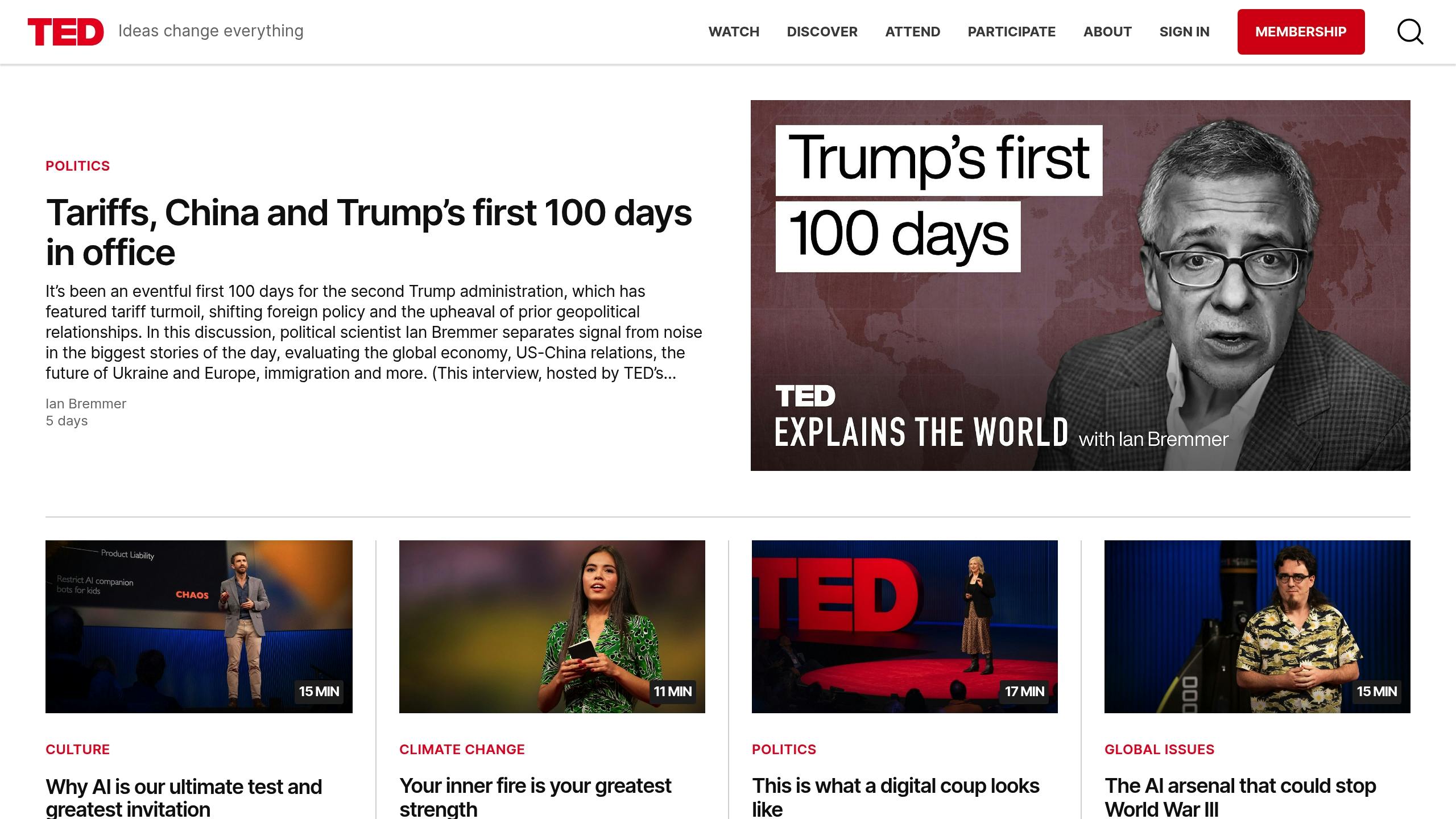
TED Talks provide engaging and thought-provoking content, but for professionals, their use as Continuing Professional Development (CPD) activities must align with strict professional standards.
TED Talk Topics for Professionals
Some TED Talks cover topics that enhance professional skills and complement the core expertise of accountants.
| Topic Area | Relevant TED Talk Example | Professional Impact |
|---|---|---|
| Team Leadership | Patrick Lencioni's "Are You an Ideal Team Player?" | Enhances leadership skills |
| Growth Mindset | Carol Dweck's "The Power of Believing You Can Improve" | Builds career resilience |
| Time Management | David Grady's "How to Save the World from Bad Meetings" | Boosts productivity |
| Professional Ethics | Adam Grant's "Are You a Giver or a Taker?" | Sharpens ethical decision-making |
Despite their usefulness, TED Talks often face challenges in meeting CPD verification requirements.
Verification Issues
One major drawback of using TED Talks for CPD is the lack of formal verification. These presentations typically do not provide:
- Attendance tracking
- Completion certificates
- Formal assessments
- Clear learning objectives
- Verifiable proof of participation
These gaps matter where your body requires independently verifiable evidence. A relevant talk may still fit another permitted CPD category, provided you keep the required records.
Learning Structure Limitations
TED Talks also present structural challenges that may not meet the formal requirements of CPD programs:
- Undefined Learning Objectives: Most talks lack clear objectives tied to professional competencies.
- No Assessment Tools: There are no built-in methods to measure knowledge retention or application.
- Informal Format: An informal presentation is not automatically excluded from CPD. Relevance, learning outcomes and your body’s rules matter.
Professionals who find useful insights in a TED Talk can apply them to their work. If you intend to claim CPD hours, document the learning outcomes and check how your body classifies the activity.
Recording TED Talks for CPD Credit
Professionals should document TED Talk learning and check the evidence required by their body before claiming CPD hours.
Writing Learning Summaries
Learning summaries explain what you learned and how it relates to your work. They can support a CPD record, but they are not automatically a substitute for independent evidence where your body requires verifiable learning.
A well-written learning summary should cover the following:
| Component | Description | Example from Practice |
|---|---|---|
| Key Insights | Core ideas and takeaways | Leadership principles from Patrick Lencioni's talk |
| Professional Application | How the insights apply to your professional role | Implementation of team collaboration strategies |
| Action Items | Steps to put the learning into action | Restructuring meeting protocols |
| Reflection | Evaluation of the learning’s impact | Adjustments in team dynamics |
CPD Activity Tracking
Record TED Talk learning in a structured way and check the evidence and retention requirements set by your professional body.
Key tracking elements include:
- Talk Details: Record the title, speaker name, and date watched.
- Duration: Record actual study time. Include additional reflection only where your body permits it, without double-counting time.
- Competency Area: Specify the professional skill addressed.
- Learning Outcomes: Note measurable impacts and how the insights were applied in practice.
Using CPDProof for TED Talks
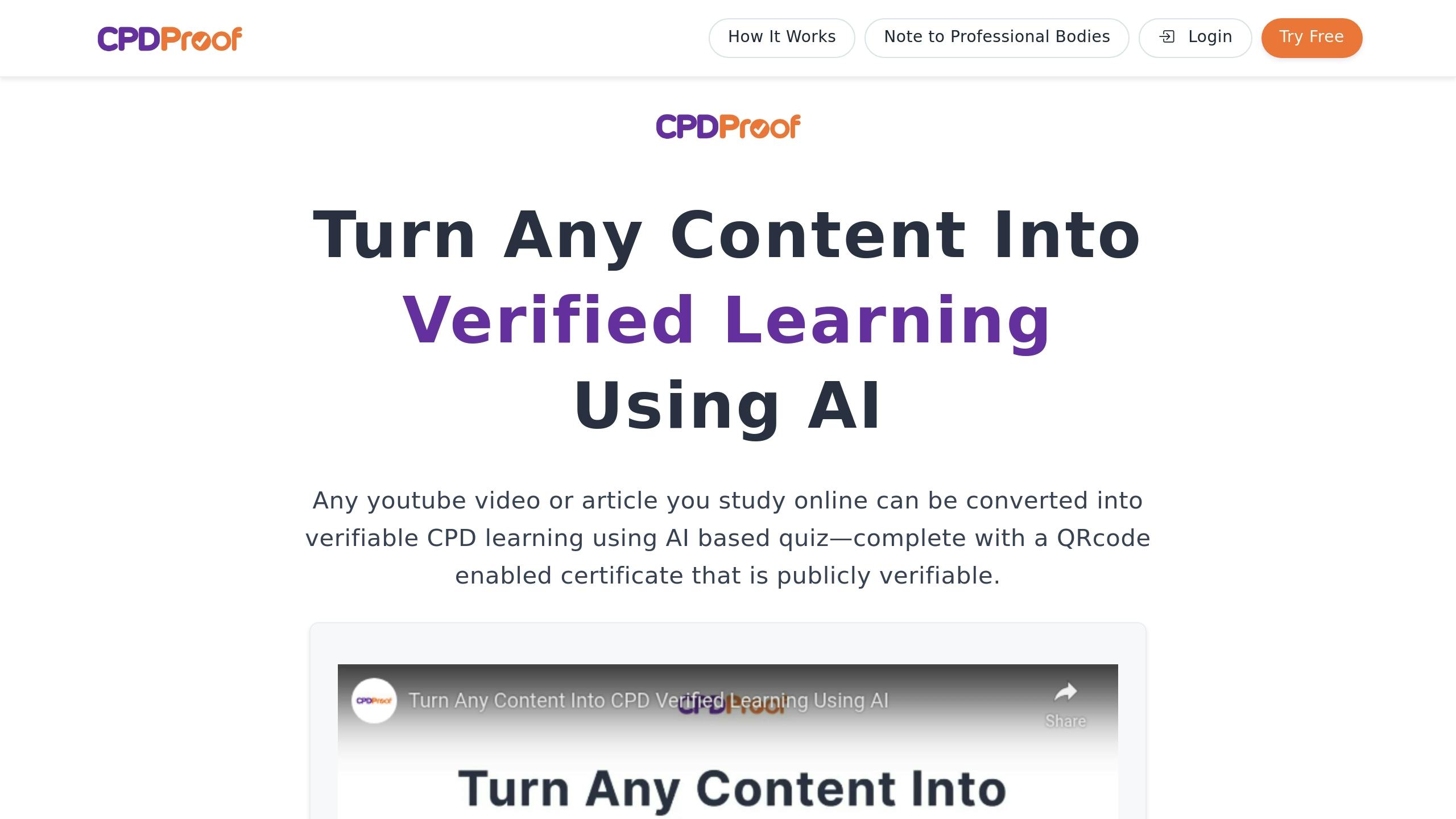
CPDProof helps you document TED Talk learning and demonstrate your understanding. It supports your evidence by:
- Allowing users to submit TED Talk details to create quizzes that evaluate understanding.
- Providing AI-generated assessments to test comprehension of key concepts.
- Issuing QR code-enabled certificates upon successful completion.
Conclusion: TED Talks and CPD Requirements
TED Talks may contribute to CPD hours where your professional body allows relevant self-directed learning and you meet its documentation requirements [5]. To get the most out of these activities, focus on their relevance, track your time, validate your learning, and show how you’ve applied the insights.
| Requirement | How to Implement | What to Document |
|---|---|---|
| Relevance | Choose talks directly related to your professional responsibilities | A summary linking the talk’s content to key skills |
| Time Tracking | Record actual study time and any additional reflection allowed by your body | Detailed records with dates, duration, and context |
| Learning Validation | Take quizzes or write reflections after watching | Quiz results or reflective notes |
| Professional Application | Record how you’ve used the insights in your work | Action steps and outcomes |
A balanced CPD plan can combine relevant TED Talks with courses, professional events and other learning. Check your body’s annual or multi-year targets, any required learning categories, ethics requirements and limits on particular activities. Do not apply one body’s hour totals or verifiable/unverifiable split to every professional membership.
FAQs
::: faq
Can TED Talks count toward CPD hours?
They may, if your professional body allows the activity and the content is relevant to your work. Check its current rules before claiming hours. A talk’s title, popularity or length does not by itself establish eligibility. :::
::: faq
How should I document a TED Talk for CPD?
Keep the title, speaker, URL, date studied, actual learning time, learning objectives and a short reflection on what you learned. Add any quiz results or completion evidence. Follow your body’s record-retention rules and its requirements for verifiable or unverifiable learning. :::
::: faq
Does a CPDProof certificate guarantee that my professional body will accept the activity?
No. CPDProof can provide an assessment and a QR-enabled completion certificate, but acceptance depends on your body’s rules, the relevance of the content and the evidence required. It does not turn a TED Talk into an accredited course. :::